
 Log in


Department of Neurobiology
Scientific profile
- About department
- Employees
- Laboratories
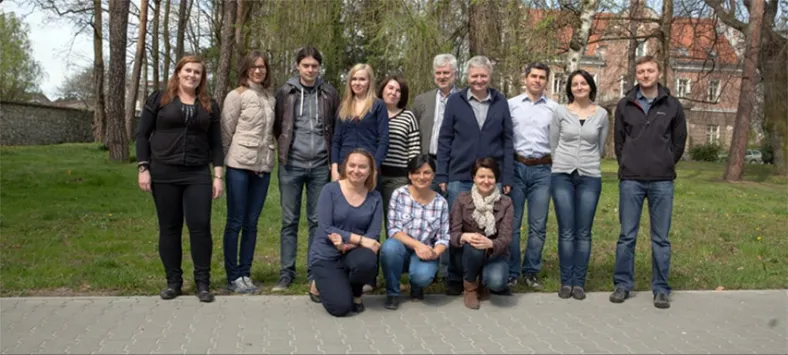
The Department of Neurobiology consists of separate research teams and the independent Laboratory of Trace Elements Neurobiology. Research teams conduct complementary studies in areas such as metabotropic receptors for glutamate and the search for new sites of action for psychotropic drugs.
The team consisting of the following members: dr hab. Agnieszka Pałucha-Poniewiera (PhD), Karolina Podkowa (MPharm) and Szymon Rzeźniczek (MSc) takes part in the study of potential antidepressant properties of glutamate metabotropic ligands and their mechanisms of action.
The team consisting of the following members: Piotr Brański (PhD), Grzegorz Burnat (PhD), Paulina Chorobik (PhD), Marcin Marcinak (PhD), Barbara Chruścicka (MSc) deals with an identification and pharmacodynamic characteristics of biologically active chemical compounds. Their studies are focused on metabotropic receptors, in particular mGluR and GABA B.
The methodology and experimental procedures
- Mammalian cell cultures
- Analysis of protein expression using RT-PCR and Western Blot
- Immunofluorescence (microscopy and FACS)
- Measurement of metabotropic receptors-mediated GTPase activity in isolated cell membranes
- Cyclic ATP measurement (cells, tissue sections) using HTRF
- Kinetic luminometric measurement of intracellular cAMP levels using a molecular sensor (Glo)
- Measurement of the IP1 accumulation (cells, tissue sections) using HTRF
- Measurement of intracellular mobilization of calcium ions (fluorescence)
- Molecular cloning (propagation of bacterial vectors, modification of DNA sequence, transfer into mammalian cells [including tetracycline-inducible gene expression system], selection of cell clones)
- Point mutations
- Experiments on transgenic animals (PCR, electrophoretic separation of products)
- Evaluation of sperm quality parameters (evaluation of: motility, vitality – eosinophilic test, maturity – presence and location of cytoplasmic droplets, integrity of cytoplasmic membrane – hyposmotic test and morphology of spermatozoids)
Dr hab. Joanna Wierońska (PhD), Monika Woźniak (MSc) and Paulina Cieślik (MSc) form a team whose main research direction are antipsychotics and their mechanisms of action. We use animal models of positive, negative and cognitive symptoms as well as techniques to determine the level of specific proteins and mRNA. Our studies oscillate around metabotropic receptors for glutamate and GABA B receptors.
The Laboratory of Neurodegeneration and Neuroprotection (no formal status), whose members are prof. dr hab. Maria Śmiałowska and Dr. Helena Domin, is involved in:
- Research on neurodegeneration and neuroprotection in experimental models of ischemia
- Study of neuroprotective and antidepressant mechanisms of glutamate group III receptor ligands and neuropeptide Y receptor ligands
- Study of anatomical and histochemical interactions between different types of neurons and astrocytes in the cerebral cortex and limbic structures. We pay special attention to GABA and NPY neurons.
Methods used
- Histology (Nissl, HE, Kluver-Barrera staining)
- Histochemistry and immunohistochemistry (NPY-ir, GAD67-ir, GFAP-ir, CRF-ir, NeuN-ir, TH-ir, TrpH-ir, immunohistochemical staining of selected receptors, and others)
- Stereological quantification in microscopic images
- Intracerebral administration of substances
- Behavioral observations and tests
- Western blot analysis of selected proteins or peptides.
The team closely collaborates with Laboratories of the Department of Neurobiology and other researchers in the Institute, especially in the field of behavior, Western blotting, neural cell cultures, and assessment of neurodegenerative changes in Parkinson’s disease models.
The Department also conducts studies regarding the anxiolytic activity of drugs and the mechanisms of action of these compounds.

Employees
Agnieszka Pałucha-Poniewiera, dr hab.
 +48 12 6623288
  nfpaluch@cyf-kr.edu.pl
  room 313
 Joanna Wieronska, dr hab.
+48 12 6623288
wierons@if-pan.krakow.pl
room 313 Professor Gabriel Nowak, dr hab.
+48 12 6623215
nowak@if-pan.krakow.pl
room Ojcowska Professor Andrzej Pilc, dr hab.
+48 12 6623284
pilc@if-pan.krakow.pl
room Ojcowska Professor Maria Śmiałowska, dr hab.
+48 12 6623270
nfsmialo@cyf-kr.edu.pl
room 32 ul. Ojcowska Helena Domin, dr hab.
+48 12 6623315
domin@if-pan.krakow.pl
room 312 Bartłomiej Pochwat, dr
pochwat@if-pan.krakow.pl
room 312 Anna Rafało-Ulińska, dr
+48 12 6623292
rafalo@if-pan.krakow.pl
room 318 Katarzyna Stachowicz, dr hab.
+48 12 6623315
stachow@if-pan.krakow.pl
room 312 Dorota Bederska-Łojewska, dr
bederska@if-pan.krakow.pl Piotr Brański, dr
+48 12 6623295
nfbransk@cyf-kr.edu.pl
room 3.20 Grzegorz Burnat, dr
+48 12 6623295
burnat@if-pan.krakow.pl
room 320 Barbara Chruścicka-Smaga, dr
+48 12 6623362
chruscic@if-pan.krakow.pl
room 319 Łukasz Gąsior, dr
gasior@if-pan.krakow.pl Michał Santocki, dr
santocki@if-pan.krakow.pl Yana Babii, mgr
+48 12 6623292
babii@if-pan.krakow.pl
room 318 Agata Machaczka, mgr
+48 12 6623362
machacz@if-pan.krakow.pl
room 319 Employees
Achievements
- Publications
- Awards
Award
L'OREAL For Women in Science
Katarzyna Stachowicz, PhD
Award
Scientific Team Award WUM
Katarzyna Stachowicz, PhD
Award
Postdoc Research position Vanderbilt University
Katarzyna Stachowicz, PhD
Down-regulation of cortical β-adrenoceptors by chronic treatment with functional NMDA antagonists
Paul, I.A., Trullas, R., Skolnick, P., Nowak, G.
DOI: 10.1007/BF02801986
The acute effect of sertindole on brain 5-HT<inf>2</inf>, D<inf>2</inf> and α<inf>1</inf> receptors (ex vivo radioreceptor binding studies)
Hyttel, J., Nielsen, J.B., Nowak, G.
DOI: 10.1007/BF01245352
Pharmacological profile of the atypical neuroleptic sertindole.
Hyttel, J., Arnt, J., Costall, B., Domeney, A., Dragsted, N., Lembøl, H.L., Meier, E., Naylor, R.J., Nowak, G., Sánchez, C.
DOI:
N-ethoxycarbonyl-2-ethoxy-1,2-dihydroquinoline, an irreversible receptor inactivator, as a tool for measurement of α<inf>2</inf>-adrenoceptor occupancy in vivo
Pilc, A., Nowak, G., Zak, J.
DOI: 10.1016/0014-2999(92)90081-E
N-ETHOXYCARBONYL-2-ETHOXY-1,2-DIHYDROQUINOLINE, AN IRREVERSIBLE RECEPTOR INACTIVATOR, AS A TOOL FOR MEASUREMENT OF ALPHA-2-ADRENOCEPTOR OCCUPANCY INVIVO
NOWAK, G, PILC, A, ZAK, J
DOI: 10.1016/0014-2999(92)90081-E
Captopril lacks the antidepressant-like activity in animal models
Baran, L., Siwanowicz, J., Nowak, G., Przegalinski, E.
DOI:
Effect of repeated treatment with electroconvulsive shock (ECS) on serotonin receptor density and turnover in the rat cerebral cortex
Nowak, G., Dulinski, J.
DOI: 10.1016/0091-3057(91)90037-3
Role of Dopaminergic Neurons in Denervation‐Induced α<inf>1</inf>‐Adrenergic Up‐Regulation in the Rat Cerebral Cortex
Nowak, G., Zak, J., Superata, J.
DOI: 10.1111/j.1471-4159.1991.tb02008.x
Down-regulation of dopamine<inf>1</inf> (D<inf>1</inf>) receptors by chronic imipramine is species-specific
Nowak, G., Skolnick, P., Paul, I.A.
DOI: 10.1016/0091-3057(91)90162-U